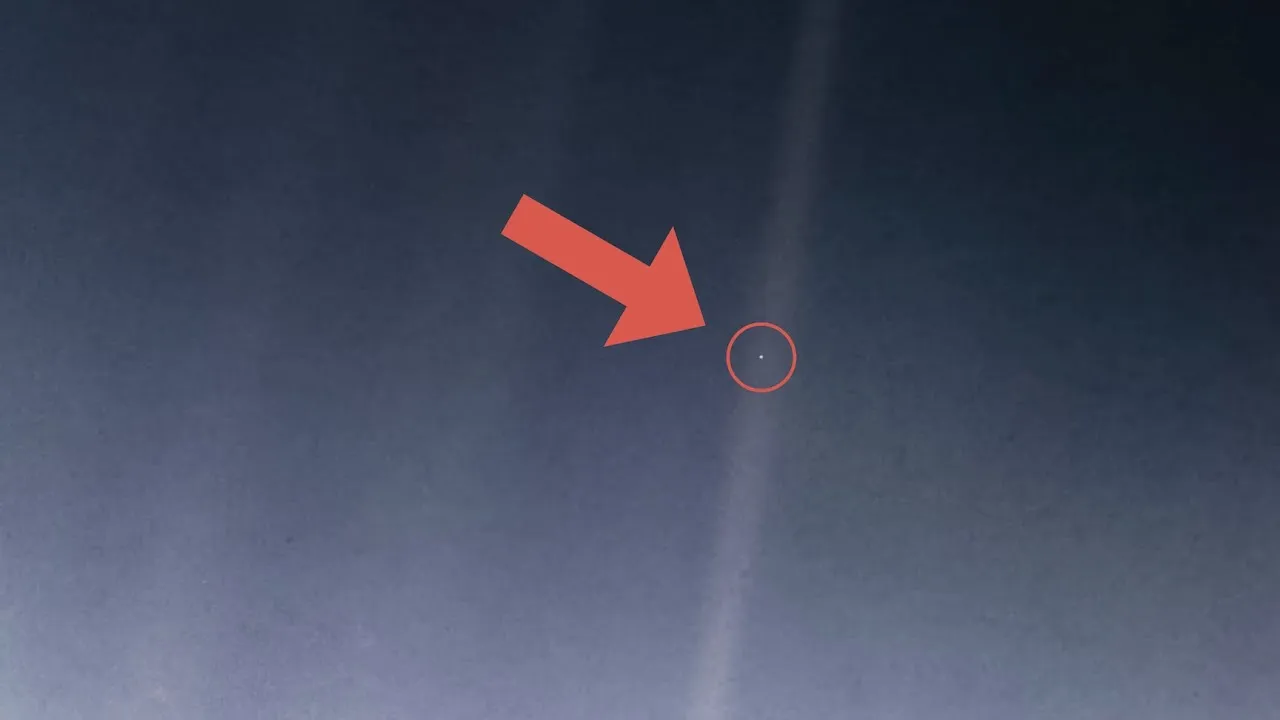
On February 14, 1990, the Voyager 1 spacecraft—after completing its exploration mission—was leaving the Solar System. It was beyond Neptune’s orbit and about 6 billion kilometers from Earth (roughly 40 times the average distance from Earth to the Sun).
Following Carl Sagan’s proposal, the spacecraft was instructed to turn around and capture a “family portrait” series of images, including the famous photograph known as “苍蓝点” (the “Faint Blue Dot”).
In the image, Earth appears as a tiny blue dot within a band of sunlight. Those bands are pseudo-images produced inside the camera due to reflections of the sunlight. In this photograph, Earth occupies only 0.12 pixels—underscoring just how small our planet is within the immense scale of the universe.
“Look again at that dot. That’s where we are. That’s our home. That’s us. On that dot, everyone you love, everyone you know, everyone you ever heard of—every human being who ever lived—spent their entire lives. The sum of our joys and our sufferings, thousands of confident religions, ideologies, and economic doctrines, every hunter and every gatherer, every hero and every coward, every creator of civilization and destroyer of civilization, every king and every peasant, every young couple in love, every hopeful child, every father and every mother, every inventor and every explorer, every teacher of morals, every corrupt politician, every ‘superstar,’ every ‘supreme leader’—every saint and sinner in the history of our species—lived there on a mote of dust suspended in a sunbeam.” — Carl Sagan